
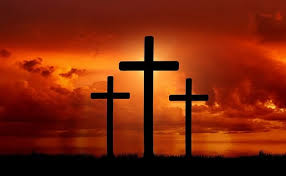
“Therefore when Jesus had received the sour wine, He said, “It is finished!” And He bowed His head and gave up His spirit” (John 19:30).
The greatest event in history was the coming of Jesus Christ into the world. He came to live and to die for mankind. The next greatest event was the Church going forth to embody the life of Christ. It spread the knowledge of His salvation throughout the earth. Christ commanded His disciples to “Go therefore and make disciples of all the nations, baptizing them in the name of the Father and the Son and the Holy Spirit, teaching them to observe all that I commanded you; and lo, I am with you always, even to the end of the age” (Matt. 28:19-20).
Jesus died for the sins of the whole world (1 John 2:2). His death, burial and resurrection paved a way for humanity to be reconciled to God (2 Cor. 5:18-21, Rom. 5:8-11), obtaining mercy and right standing with Him. Through Christ’s substitutionary death for sin on the cross, He provided salvation. He reconciled sinful mankind with a holy and righteous God. Christ’s death and payment of the penalty of sin has provided a means of completely changing our relationship to God.
Apostle Paul poignantly said in 1 Corinthians 15:3-5, “For I handed down to you as of first importance what I also received. Christ died for our sins according to the Scriptures. He was buried. He was raised on the third day according to the Scriptures. He appeared to Cephas, then to the twelve.” From that time on Jesus began to show His disciples that He must go to Jerusalem and suffer many things at the hands of the religious sect (elders, chief priests, and scribes), and that He must be killed and on the third day be raised to life.
In preparation for this post I began to ponder the significance of the third day. In scripture the number 3 conveys the meaning of completeness. Jesus prayed three times in the Garden of Gethsemane before His arrest. He was placed on the cross at the 3rd hour of the day (9 a.m.) and died at the 9th hour. There were 3 hours of darkness. Darkness covered the land while Jesus was suffering on the cross. This occurred from the 6th hour to the 9th hour.
Of the last sayings of Christ on the cross, none is more important or more poignant than, “It is finished.” Jesus knew that all things had already been accomplished. This was so that the Scripture be fulfilled. He then said, “I am thirsty.” A jar full of sour wine was standing there. They put a sponge full of the sour wine on a branch of hyssop. They brought it up to His mouth. So when Jesus had received the sour wine, He said, “It is finished!” And He bowed His head and gave up His spirit (John 19:28-30).
Wine was used as a symbol of blessing and judgment throughout the Bible. The Bible mentions hyssop in religious ceremonies, and because of its ceremonial use, it is a symbol for cleansing. As Jesus spoke these final words, justice was served on the cross. A pathway was opened for all believers. They have the opportunity to be cleansed and set free from the ravishing effects of sin. Christ showed his love for humanity. While we were still sinners, he died for us. He cleansed all who believed from unrighteousness. 1 John 1:9, “If we confess our sins, he is faithful and just to forgive us our sins and to cleanse us from all unrighteousness.”
The resurrection of Jesus Christ is about justice – God’s justice. Justice is making things right by God’s standards. He is just. He is perfectly righteous in His treatment of His creatures. He shows no partiality (Acts 10:34). He commands against the mistreatment of others (Zechariah 7:10), and He perfectly executes vengeance against the oppressors (2 Thess. 1:6; Rom. 12:19).
God is just in meting out rewards. “God is not unjust; he will not forget your work and the love you have shown him. You have helped his people and continue to help them” (Hebrews 6:10). He is equally just in meting out punishments: “Anyone who does wrong will be repaid for their wrongs, and there is no favoritism” (Col. 3:25). Justice and righteousness, which always work hand in hand, are the foundation of God’s throne (Ps. 89:14).
The Hebrew word for “justice,” mishpat1, means to treat people equitably. It speaks of social order as well as legal equity (fairness), and establishing justice in society. The mishpat, or justness, of a society, according to the Bible, is evaluated by how it treats its people. Neglecting the needs of the people is more than just lacking mercy or charity. It is a violation of justice (mishpat). God loves and defends those with the least economic and social power, and we should also. That is what it means to “do justice” (Micah 6:8). Justice is making what’s wrong right. Psalm 106:3 tells us that those who keep justice will be blessed.
Righteousness or tzedakah2 means “righteousness or righteous behavior.” We should practice righteous behavior at all times! Righteousness is key to building a peaceful, progressive and thriving nation and happy people. Sin, unrighteousness, oppression, racism, inequality and wickedness bring disaster and woes to nations and peoples. “When the righteous thrive, the people rejoice; when the wicked rule, the people groan” (Prov. 29:2).
God is perfectly just. He does not change. God is not human, that he should lie, He does not change his mind (Numbers. 29:13). Jesus Christ is the same yesterday and today and forever (Heb. 13:8). “Every good thing given and every perfect gift is from above, coming down from the Father of lights, with whom there is no variation or shifting shadow” (James 1:17).
May the grace, joy and peace be yours through Jesus Christ our loving Lord. To Him be glory, now and forever.
Blessings,
Minister Dr. A. Francine Green
Notes:
New American Standard Bible (NASB) unless otherwise noted.
 afrancinegreen.com