
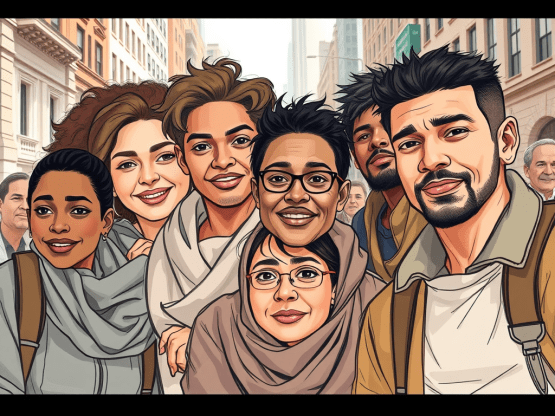
Understanding Unity and Purpose Through Acts 17:26
In our busy and often divided world, it’s easy to fall into the mindset of “us vs. them.” We might see people as different from us because of where they’re from, what they believe, or how they look. But what if we paused and remembered that, deep down, we’re all part of one big family? This isn’t just a nice thought—it’s a truth rooted in the Bible, specifically in Acts 17:26:
“From one man he made all the nations, that they should inhabit the whole earth; and he marked out their appointed times in history and the boundaries of their lands.”
Let’s talk about what this means in simple terms and how it can help us see one another differently.
We All Come from One Source
Imagine a tree. Its branches may spread far and wide, reaching in every direction, but they all lead back to a single trunk—and that trunk grows out of one set of roots. The verse from Acts reminds us that God made all people from “one man.” In other words, no matter how different we seem on the surface—no matter our language, culture, or skin color—we all share the same roots.
This idea is powerful because it means the person across the street, across the border, or across the world is not a stranger, but a distant relative in God’s family. We are connected in ways deeper than we often realize.
God’s Plan for Diversity
Some people might wonder, “If we all come from the same place, why are we so different?” The second part of the verse gives us a clue. God intended for people to spread out and live all over the earth, forming different nations and cultures. This wasn’t an accident or a mistake—it was part of God’s design.
Think of it like a beautiful patchwork quilt. Each piece of fabric has its own color and pattern, but together they make something much more vibrant and interesting than any single piece alone. Our differences—our languages, traditions, and ways of life—are part of what makes humanity beautiful.
Divine Timing and Boundaries
The verse also says that God “marked out their appointed times in history and the boundaries of their lands.” This means that not only did God plan for us to be different, but also decided when and where each group of people would live. The country or city where you were born, the era in which you’re living—all of this is known and cared for by God.
This might raise more questions than answers. Why did God choose these times and places for each of us? While we may not fully understand, this verse reassures us that our lives are not random or meaningless. We are here, now, for a reason.
Purposeful Creation
If God took such care in making us and placing us where we are, it points to a bigger purpose. Later in Acts 17, we see that God did all this so that people would seek Him and perhaps reach out for Him and find Him. Our differences and distances are not meant to separate us from God—or from each other—but to encourage us to look beyond ourselves, search for truth, and discover the love of our Creator.
That means every person you meet is on their own journey, with their own story and their own reasons for being where they are. When we see others with this perspective, it’s harder to judge or reject them. Instead, we find room for curiosity, compassion, and respect.
Moving Past “Us vs. Them”
So how do we put this into practice?
· Remember our shared roots. The next time you feel tempted to dismiss someone because they’re “not like you,” remember that you’re both branches from the same tree.
· Appreciate differences as part of God’s design. Diversity isn’t a mistake—it’s a gift. Other people’s traditions, foods, music, and customs add color to the world and teach us new things.
· See God’s hand in where people are. Whether you’re in your hometown or traveling somewhere new, remember that God has placed people all over the world for a reason. Every person is where they are as part of a bigger story.
· Look for purpose in your life and others’ lives. If God has a plan for nations and history, He has a plan for you, too. And He has a plan for your neighbors, coworkers, and even those you might call “strangers.”
· Let curiosity replace suspicion. Instead of thinking, “They’re different, so I can’t trust them,” try asking, “What can I learn from them? What stories and experiences have shaped who they are?”
· Practice compassion and kindness. When we remember our common humanity and God’s love for all, it becomes easier to treat others with respect and care, even when we disagree.
The Power of Perspective
At the end of the day, much of the “us vs. them” mindset comes from fear or misunderstanding. When we focus too much on differences, we forget the things that connect us. But when we step back and see the bigger picture—that we are all created by God, all part of His plan, all meant to seek Him—we can let go of fear and embrace unity.
This doesn’t mean we give up our own beliefs or traditions. It doesn’t mean we ignore real problems or pretend everyone thinks the same. But it does mean we start from a place of respect, seeing others as fellow travelers on the same journey.
Living It Out
How can we make this real in our daily lives? Here are some simple ideas:
· Start small. Smile at a stranger. Greet your neighbor. Listen before you respond in a conversation.
· Get to know people who are different from you. Share a meal with someone from another background. Ask about their culture or traditions. You might be surprised by what you learn.
· Stand up for unity. When you hear “us vs. them” talk—whether about race, nationality, religion, or anything else—gently remind others (and yourself) that we’re all part of God’s creation.
· Pray for perspective. Ask God to help you see others as He sees them: with love, care, and purpose.
Conclusion: One Family, Many Faces
Acts 17:26 is more than just a history lesson; it’s an invitation to see the world—and each other—through God’s eyes. It reminds us that we are all connected, all cared for, and all called to seek something greater than ourselves.
Imagine a world where we truly lived this out. Where every person, no matter their background, was treated with dignity and respect. Where differences were celebrated, not feared. Where we reached out with love instead of building walls of suspicion.
That world starts with each of us. It starts with seeing our neighbor not as “them,” but as another beloved part of God’s creation—just like us.
Let’s take that first step today.
Minister A Francine Green – July 2025
 afrancinegreen.com