
Understanding Our World Through History’s Deepest Turning Points
Introduction: Why the Conquest of the Americas Still Matters
When you look around at the world—its languages, cultures, religions, and even the big divides between rich and poor—you’re seeing the ongoing effects of events that took place more than 500 years ago. It all started when Europeans set foot on the continents we now call the Americas. You may picture Columbus arriving in 1492, Spanish conquistadors marching inland, or ships loaded with gold and silver heading to Europe. But the real story is both broader and deeper, rippling through time to shape modern life in ways we hardly notice.
This post breaks down, in everyday language, just how much the European conquest of the Americas—and the idea of Manifest Destiny—changed the world. From population collapse, to the mixing (and loss) of cultures, to new social orders and the birth of powerful myths, these are the forces that built the world we live in.
Demographic Consequences: The Collapse of Whole Peoples
The most shocking and immediate result of the European arrival in the Americas was a massive loss of life. Before 1492, the Americas were home to thriving civilizations: from the Aztecs and Maya in Central America, to the Inca in the Andes, to hundreds of smaller nations and tribes. Scholars think that as many as 60 to 100 million people lived in the Americas before European contact—far more than many once believed.
But along with explorers and soldiers, Europeans carried invisible invaders: diseases like smallpox, measles, and influenza. The Native peoples had never been exposed to these illnesses, so their immune systems had no defense. Imagine if a new flu, deadlier than anything before, arrived in your town—and hardly anyone had any resistance. Within just a few decades, whole communities were wiped out. Some estimates suggest that up to 80–90% of the Indigenous population died in the first century of contact.
But the disaster didn’t stop there. When so many people died, fields went untended, cities crumbled, and ancient knowledge was lost. To fill the labor gap, the forced importation of enslaved Africans began—the start of the brutal transatlantic slave trade that would later shape societies in the Americas, Africa, and beyond.
Cultural Consequences: Clashes, Change, and Blending
The conquest wasn’t just about swords, guns, and gold. It was also a clash of cultures. European nations—mainly Spain, Portugal, England, and France—brought their languages, religions, customs, laws, and worldviews. They often saw their ways as superior and tried to erase local traditions.
Suppression of Native Ways
Newcomers destroyed temples and sacred sites to build churches and colonial buildings. They banned or punished Indigenous languages and rituals. For many centuries, speaking a Native language could mean being punished or shamed. Old religious leaders lost their power, while Christian priests and colonial officials took charge.
You can see traces of this history today: many central plazas in Latin American cities have grand cathedrals built atop the ruins of ancient temples—a literal symbol of one culture taking over another.
The Birth of New Societies
But cultures are not so easily erased. Over generations, Indigenous people, Europeans, and Africans mixed, sometimes by force, sometimes by choice. This process—called “mestizaje” in Spanish-speaking Latin America—created entirely new groups of people and cultures.
Today, you can see it in the foods people eat: tortillas and corn from Native traditions, beef and cheese from Europe; chocolate, tomatoes, and potatoes went from the Americas to Europe and changed diets worldwide. You hear it in languages, music, and holidays, where Catholic saints and local deities blend together. New art forms, dances, and ways of life were born from the collision—and resilience—of older cultures.
At the same time, many original languages and traditions were lost or nearly wiped out. Today, many people in the Americas are working to revive and celebrate Indigenous cultures, showing that these roots still matter and still survive.
Social Consequences: New Hierarchies, Lasting Inequalities
The conquest didn’t just change who ruled; it changed how societies were built. The Spanish and Portuguese, for example, set up the “encomienda” system, where Spanish settlers could claim land and force Indigenous people to work for them. Even when slavery was officially outlawed, many Native people continued to live under harsh labor systems, hardly better than slavery itself.
Europeans sat at the top of the new social pyramid. Below them were mixed-ancestry people—mestizos (European and Native), mulattoes (European and African), and others—while people of pure Indigenous or African descent were often at the bottom. Laws were made so that skin color and ancestry determined what jobs you could get, whether you could own land, which schools you could attend, and even who you could marry.
Though many of these old laws are gone, the inequalities they created are still visible in today’s Americas. Wealth and power often remain concentrated in the hands of the descendants of Europeans, while many Indigenous and Afro-descendant communities continue to face poverty and discrimination.
How People Saw the World Differently
Tzvetan Todorov, a historian and philosopher, wrote that the conquest wasn’t just about land, gold, or new foods—it also changed how people thought. After the conquest, Europeans saw themselves as the “norm” and everyone else as different or “other.” They used this idea to justify taking land and ruling over others, laying the groundwork for later ideas about race and racism—not just in the Americas, but around the world.
But Todorov also pointed out that something new was created from all this destruction: new societies, new languages, new ways of thinking and living. It’s a legacy both bitter and beautiful.
Lasting Effects in Today’s World
We don’t have to dig far to find the ongoing effects of the conquest:
· Diversity and Inequality: Most countries in the Americas are a mix of peoples—European, Indigenous, and African. At the same time, deep social and economic gaps, often along racial lines, remain as a legacy of colonial times.
· Languages: Spanish and Portuguese are now the main languages in Latin America, but movements are growing to revive and protect Indigenous languages.
· Religion: Christianity, especially Catholicism, dominates, but in many places it’s blended with traditional beliefs and rituals.
· Culture: From street food to music, art, and festivals, the mixing of cultures begun during the conquest shapes daily life.
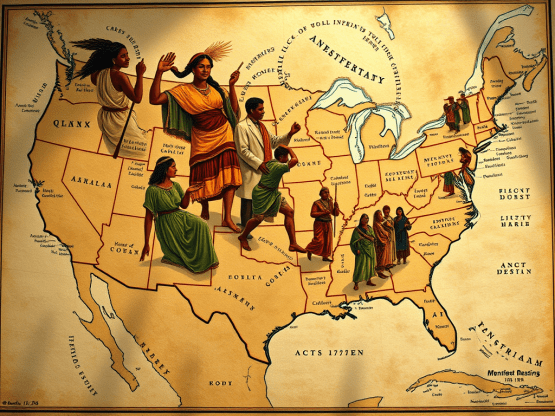
Manifest Destiny: An American Expansion Myth
Manifest Destiny is a phrase you might hear in American history class. It describes the belief, especially popular in the 1800s, that the United States was “meant” to expand across the continent—from the Atlantic to the Pacific.
The phrase was first used in 1845 by John L. O’Sullivan, who argued that it was the nation’s “manifest destiny” (obvious fate) to take over the land that Providence (God) had given. This belief didn’t come out of nowhere; it was built on earlier ideas that Americans were special or chosen to build a new society.
By tying politics to faith, leaders made it seem as if taking over new land was a sacred mission. This belief was used to justify things like the Louisiana Purchase, annexing Texas, the Mexican-American War, and especially the forced removal of Native Americans from their lands—for example, the Trail of Tears.
Justifying Expansion, Ignoring Harm
Throughout history, powerful groups have used religion to claim that their actions are “God’s will.” Manifest Destiny was no different. It gave people a reason not to feel guilty about taking land or fighting wars, even though it meant suffering for Native peoples.
Consequences of Manifest Destiny
The push west changed the country, but not all those changes were positive:
· Native American nations were forced off their lands; their cultures were attacked or destroyed.
· The Mexican-American War led to the U.S. taking over huge parts of what’s now the western United States.
· Natural resources were exploited, and the environment was often damaged without thought for the future.
· The new lands made the debate over slavery even worse, leading toward the American Civil War.
For Indigenous communities, Manifest Destiny was a disaster. Laws and government actions forced them from their homes and resulted in immense suffering—all in the name of “progress” or “God’s plan.”
Questioning the Myths
Today, many people look back and ask: Was Manifest Destiny really about God’s will, or just a way for powerful groups to get what they wanted? Many faiths teach kindness, humility, and justice for all people—not taking land through violence. We now know that such justifications often twisted religious values for political gain.
The Legacy of Conquest and Destiny Today
Even now, the legacies of the conquest and Manifest Destiny remain. They’re often visible in the way history is taught, in who holds wealth and power, and in the ongoing struggles for justice among Indigenous and other marginalized communities.
Modern activists, historians, and Indigenous groups are working hard to tell the fuller story. They remind us that real greatness comes not from conquest, but from fairness, truth, and respect for everyone.
Conclusion: Learning and Moving Forward
The conquest of the Americas and the belief in Manifest Destiny are not just events stuck in the past. They are living stories, still shaping the languages we speak, the foods we eat, the religions we follow, and even the inequalities we see around us.
By understanding what really happened, we can see why the world is the way it is—and work toward a future that values diversity, recognizes injustice, and celebrates the creative power that comes from many cultures coming together. Remembering and questioning the stories we’ve inherited isn’t just about the past. It’s how we build a better, fairer, and more honest world for everyone.

 afrancinegreen.com